
Luxury Self-Catering Cabins in Scotland
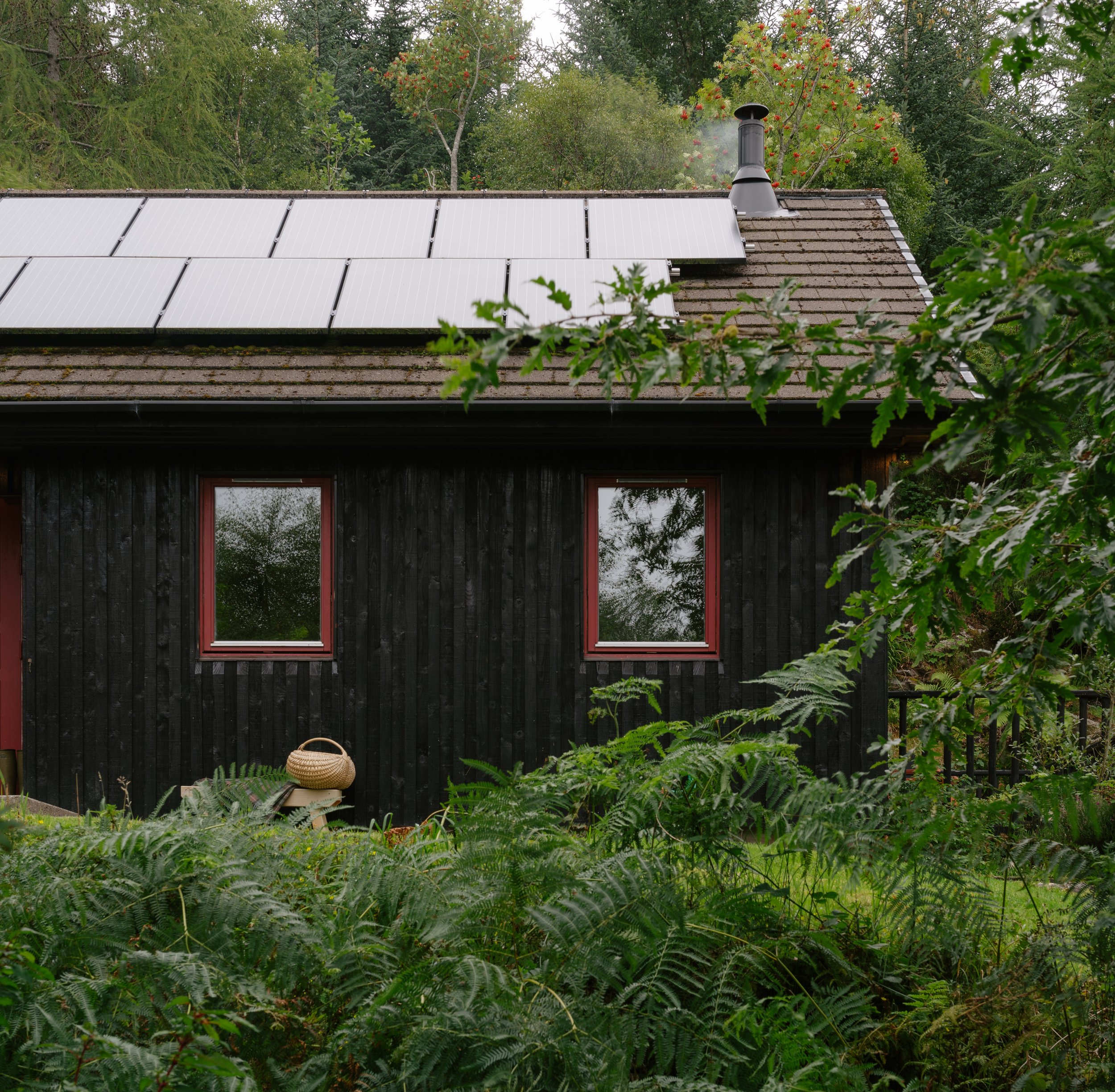
Borradill Cottage
What to Look For (and Where We Think We Stand)
Published by Borradill | Glenborrodale, Ardnamurchan Peninsula
The word "luxury" is not our favourite because it means very different things to different people. Because we use it too as it seems to be an important descriptive term on the internet, we thought it was worth saying what we actually mean by it – and where, in our honest assessment, we think Borradill measures up and where it doesn't pretend to be something it isn't.
This is meant to be genuinely useful if you're comparing self-catering options in Scotland.
1. Does the design serve the place, or obscure it?
The best self-catering interiors in Scotland do something specific: they extend the experience of the landscape rather than provide a retreat from it. A loch-view cabin that seats you facing a feature wall is a missed opportunity. Picture windows, considered sightlines, furniture arranged around the view rather than the television – these are design decisions, not incidental ones.
At the same time, there's a category of "designed" Scottish holiday let that has become its own cliché: a particular shade of grey-green paint, a stag skull on the wall, a tartan throw on a mid-century chair, artfully arranged driftwood. It signals effort without really connecting to the specific place the building is in.
What we've tried to do at Borradill: The cabins were crafted in Sweden and designed in a Scandi-Hebridean style – partly because this is genuinely where the two traditions meet on the west coast, and partly because Swedish timber construction and the traditional Highland bothy share an underlying logic: materials honest to their environment, built to last, without excess. The picture windows in both the House and the Cottage are oriented to Loch Sunart. The artworks on the walls are by Scottish artists and reference the landscape. The furniture includes pieces that were chosen over time rather than sourced from a single trade catalogue.
We are a design practice, Mookerjee Design, as well as a cabin owner, which means we notice these things – and it means we hold ourselves to a higher standard on them than we might otherwise.
2. Is "remote" actually remote, or just rural?
There is a meaningful difference between a cottage in a small village that requires a car to get to the nearest shop, and a property that is genuinely, physically isolated. Both get described as remote. They are not the same experience.
True remoteness – no other buildings in your sightline, no road noise, silence as a default rather than an occasional condition – is increasingly rare and, for many people, the actual thing they are looking for when they book a Highland retreat. It is also genuinely harder to find than listings suggest.
At Borradill: The two cabins are set 100 metres apart in 25 acres of woodland on the Ardnamurchan Peninsula. There are no other buildings in sight from either property. The nearest shop is a 15-minute drive. The road to the cabins is a single track. The peninsula itself receives a fraction of the visitor numbers of Skye or the Cairngorms. The sea loch below is a Marine Protected Zone – it is not overlooked by a car park or a visitor centre. The silence at Borradill is actual silence, interrupted by birds, wind, and water. This is worth verifying wherever you book – look at satellite images, not just property photography.
3. How is the property heated and powered, and does it matter?
For a long stay in Scotland, particularly outside summer, heating is not a luxury consideration – it is a practical one. Wood burners and log fires are aesthetically appealing but require management, and a property that relies on them as the primary heat source will be cold in the morning until you've been up for an hour.
The best properties have both: efficient background heating that holds the temperature overnight, and open fires or wood burners for the pleasure of them in the evening. The question is whether the fire is the heating system or a supplement to it.
At Borradill: Both the House and the Cottage have wood burning stoves for warmth and atmosphere. The wider properties are insulated to a high specification and equipped with solar panels – the EPC rating of the buildings is C (69). The ethos across the site is environmental: all paints are natural and free from VOCs, all timber is from sustainable sources, much of the furniture is reused or from sustainable brands, and cleaning products are Ecover throughout. This is an eco project built on a long-term commitment to the 25-acre woodland, which is being gradually restored to indigenous Atlantic rainforest.
We mention this not because it is a selling point in the conventional sense but because it affects the experience of being there – the smell of the interior, the quality of the air, the sense that the property sits within its landscape rather than on top of it.
4. What does the kitchen actually allow you to do?
Self-catering is only as good as the kitchen. A property that asks you to cook for a week and provides two blunt knives, a thin-based saucepan and a hob with uneven heat is asking you to have a worse holiday than you paid for.
The things that matter: a good range cooker or equivalent, knives that have been sharpened within living memory, a kitchen with enough workspace to prepare food properly, and decent storage.
At Borradill: The House has a range cooker and a kitchen designed to seat and feed groups of up to ten. Kitchen basics are provided – tea, coffee and olive oil. Dishwasher tablets, washing-up liquid and laundry tablets are all Ecover. We are in an area with exceptional local produce – venison, scallops, langoustines, foraged mushrooms and herbs are all available locally, and a cabin kitchen that can handle them properly is part of the point of being here.
5. What happens on a rainy day?
This is the question Scottish holiday lets are sometimes reluctant to answer directly, because the truth is that Scotland has rainy days, and a property that is only good in good weather is only good sometimes.
The best self-catering properties have thought about this and provided for it: enough interior space and varied rooms that people are not on top of each other, enough books and games and activities that a day inside becomes something other than a disappointment, and enough atmosphere that being inside is itself part of the experience rather than a failure.
At Borradill: The House is 1,600 sq ft – generous enough for a family group of six to spread out. There is a separate movie snug with a television and Bose speakers. There is a games table, a library cabinet, multiple reading nooks and seating areas. There is a dining table that seats ten for indoor lunches and longer games. The woodland provides its own rainy-day logic – a walk in the rain in a larch wood with waterproofs and wellies is a different and often delightful experience, and the paths through the 25 acres are accessible year-round. The Cottage, at 550 sq ft, is designed more as a two-person (or four with children) bolt-hole: smaller, cosier, more suited to two people who want to be close than to a group that needs space.
6. Is dog friendly actually dog friendly?
"Dog friendly" on a holiday let listing can mean anything from "we will tolerantly accept your dog if you pay a significant surcharge and keep it off all the furniture" to "this property was genuinely designed with dogs in mind." The gap matters, particularly if you are bringing a large or muddy dog to the Highlands.
At Borradill: Both the House and the Cottage are dog friendly. There are dog washing stations, dog bowls and dog towels. The boot room at the House is designed for exactly the kind of returning-from-a-walk chaos that involves wet dogs, muddy boots and children who have fallen in a burn. There is a £50 per dog charge per stay. The woodland and surrounding land is ideal for off-lead walking. We ask that dogs are kept off the beds and furniture – but beyond that, this is designed to be a place that works properly for dogs.
7. What does the listing not show you?
Good holiday let photography is good at showing you rooms. It is less good at showing you what it feels like to arrive at a property, what the approach road is like, what the views actually are from the furniture you'll be sitting on, whether the neighbouring property is 10 metres away, and what the noise environment is.
Questions worth asking before you book anywhere:
What is the nearest neighbouring property and how far away is it?
Is the view from the living room the same as the view in the main hero photograph?
Is there road noise at the property?
What is the mobile signal like?
Is the property suitable for the specific season you're visiting?
At Borradill: We have tried to address this honestly across our site. Both cabins have no neighbouring buildings in sightline. The view from the living areas of the House is directly across Loch Sunart – this is the actual view from where you sit, not a view from a specific spot in the garden in optimal light. There is mobile signal for most UK providers, and superfast broadband – the peninsula is remote but not off-grid. The nearest shop is 15 minutes away, and we say so directly rather than describing the location as "close to local amenities."
The Short Version
If you are looking for a luxury self-catering cabin in Scotland, these are the things that separate a genuinely good property from a well-photographed one: design that connects to the specific place rather than a generic Highland aesthetic; actual, verifiable remoteness rather than relative rurality; honest eco credentials rather than a token gesture; kitchens and interiors designed for how people actually behave on a week's holiday; rainy-day provision that is more than a jigsaw puzzle; and a dog-friendly policy that means what it says.
We think Borradill does well on most of these. We are an interior design practice operating our own demonstrator property, which means we hold the interiors to a higher standard than a pure investment property would. The eco project at Borradill – the woodland restoration, the sustainable materials, the VOC-free paints and Ecover cleaning products – is a long-term commitment measured in decades, not a marketing checkbox. The remoteness is real.
Where we would be honest about limits: we are not a hotel. There is no concierge, no restaurant, no pool, no spa treatment. The cabins ask you to bring food, light fires, and manage your own holiday. For many people, that is the luxury – being left alone to do things at your own pace in a beautiful place. But if you want staff and services, this is not that kind of property.
Borradill in Summary
The House – 1,600 sq ft, sleeping 4–6 (up to 10 for meals), range cooker, two bathrooms, boot room, movie snug, games table, library, deck overlooking Loch Sunart. Dog friendly. Ideal for families, multi-generational groups and friends.
The Cottage – 550 sq ft, sleeping 2–4 across two bedrooms, wood burning stove, deck and fire pit, birch glade setting beside the heron pond. Dog friendly. Ideal for couples and close friends.
Both sit on 25 acres of mixed woodland on the Ardnamurchan Peninsula, West Highlands of Scotland – one of the most remote, ecologically significant and least touristed areas of the British mainland.
Featured in The Times, the Guardian, the Financial Times, the Daily Telegraph, and Homes & Interiors Scotland. Listed on Sawdays and Plum Guide.
Borradill, Glenborrodale, Acharacle PH36 4JP | hello@borradill.com | +44 7979 696265
